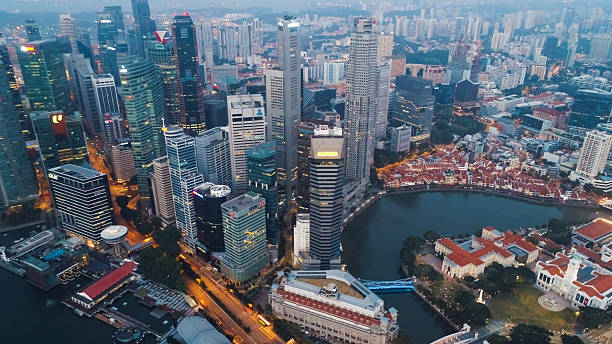
The discussion of wealth management in Singapore has always been a serious affair. Decades of institutional prudence have shaped the city-state’s culture around money, influencing how its people think about CPF allocation, property as a primary asset class, and the financial planning culture that private banks and independent financial advisors have developed locally. In that context, the emergence of a product known as a contract for differences as a topic in wealth education represents a meaningful development, one consistent with evolving client demographics and a broader shift in what sophisticated retail investors expect to understand about the instruments they use.
The settings in which this education is taking place range from formal seminars organized by MAS-licensed brokers to smaller, curated sessions conducted by family offices and boutique wealth advisory firms. The audience is typically older than one might expect, comprising professionals in their late thirties to mid-fifties who have been investing for some time and are looking to move beyond their current product range. The idea of contract for differences is not merely a thrill for this group; it is a tool that offers strategic applications, including hedging against existing equity holdings, gaining short-term exposure to a stock without borrowing, or establishing a short position in an asset class not conveniently covered by an existing portfolio.
The learning context shapes how the material lands. An audience focused on wealth outcomes responds differently to discussions of leverage and amplified returns than to discussions of instrument attributes and practical applications. A more seasoned investor with two decades of diversified portfolio experience brings different questions to a new instrument than a newer participant looking for opportunity. The former wants to understand how the instrument interacts with existing holdings, how it is treated within Singapore’s tax environment, and what the regulatory framework actually requires of participants.
Singapore’s tax environment shapes the conversation in a specific way. CFD returns are not considered capital gains in Singapore and therefore do not incur tax liability. That is a feature that improves net returns relative to a simple gross performance comparison, and it appears frequently in wealth circle discussions as something worth understanding properly. Financial advisors working in this space report that the tax dimension frequently reframes the discussion in ways that increase client comfort.
Responsible wealth education treats risk disclosure as central to the presentation of this instrument. As a leveraged product, the same flexibility and capital efficiency that make it appealing also allow positions to move against the holder at a speed and magnitude that unleveraged instruments cannot produce. Those who handle this dimension most effectively spend more time on position sizing, margin management, and scenario analysis than on the instrument’s potential upside. That balance signals to the audience that the educational intent is genuine rather than promotional, a distinction that matters in professionally oriented settings.
The increased focus on CFD education in Singapore’s wealth circles reflects a convergence of what was once the active retail trader’s domain and the more considered, portfolio-driven approach of serious wealth management. The instruments have not changed, but the audience engaging with them has broadened, and the quality of the conversation has improved considerably.
 Ethan Rogers